
Custom Search

Chief Nanaquiba
(Aniquiba/Nah-Nah-Qua-Bah/Nanabougou/Wanaquibe)
Respected Chief and Warrior
of the Potawatomi Nation
(1720-1790)
Chief Nanaquiba, biological great grandfather to Chief Abram B. Burnett, was a highly respected chief of the Potawatomis in the 18th century and was noted as one of the greatest chieftans the Potawatomis ever had. He was well known for his tactical decisions in battle and protecting his people. Nanaquiba grew to be a very wise old man. Even in his old age, he was still so respected that he continued to hold his young warriors with a firm hand. He helped the French forces lead the attack on British troops Led by Lieutenant Colonel George Munro. General Marquis De Montcalm, who was documented as the most brilliant French general of the colonial period, led the French.
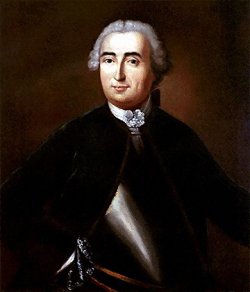
Above: General Louis Joseph de Montcalm
Lieutenant Colonel George Munro's British 35th Regiment of Foot and Elements of the 60th Foot Militia Troops had resisted a long siege and bombardment by the French and a large number of Indian warriors. Defended by approximately 2,200 soldiers commanded by Colonel Munro, Fort William Henry, a modest installation could only hold 500 people, which forced the remainder to dig trenches outside the walls. Fort William Henry would fall. The British surrendered after parlaying with Montcalm. Though stubborn and reluctant to surrender, Munro eventually gave in after being shown an intercepted message from General Daniel Webb, the commander of British forces in the New York colony, who said that he would be unable to send reinforcements to relieve the beleaguered Garrison. Defense of the lakes frontier was left to General Daniel Webb who advanced on Louisbourg with 6,000 troops. Webb was supposed to dominate Lake George to prevent the French from bringing cannons from Fort Carillon to besiege the vulnerable Fort William Henry. But he blunderred badly by relying too heavily on the frontier irregulars known as Rogers Rangers, who were severely defeated near Fort Carillon.
General Daniel Webb had visited Fort William Henry but withdrew to the safer confines of Fort Edward after receiving reports of the advent of the large French army. Thus, with little hope of relief, Munro agreed to Montcalm's terms, which allowed the British to leave Fort Edward in possession of their side arms and a token cannon. Montcalm allowed them to retreat without being attacked. The vast number of warriors that came to join Montcalm came in the early summer of 1757. They were the spearhead Montcalm used to bring down Fort William Henry. The French had stirred Indian interest by promises of a great plunder and revenge in the conquest against the British. Approximately 2,000 Indian braves joined 6,000 French regulars, some having travelled 1,500 miles to get to Fort William Henry. Some tribes present at the battle for the French were Potawatomis, and Menominees from lower Michigan, Ojibwes from Lake Superior, Ottawas from upper Lake Michigan, Miamis, Delawares from Ohio, Winnebagos from Wisconsin, and Sauk and Fox from even further west. All Native American tribes present would be a mix of Algonquian and Iroquoian speaking nations.
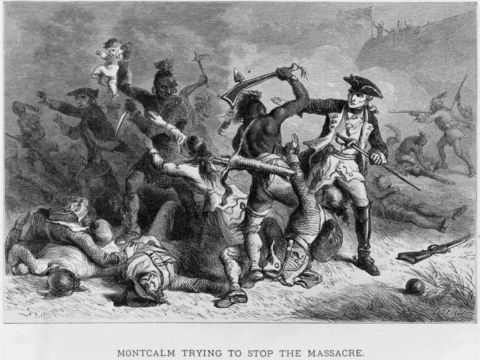
Above: Montcalm trying the stop the massacre.
Image from United States Library of Congress
For more information on the Battle of Fort William Henry, please visit Lake George Historical Association and Museum
After the British withdrawal, French allied Native American chiefs and warriors grew angry about the parlay and attacked and killed a few hundred of the 2,200 soldiers and civilians in the column leaving the fort seeking revenge and continuing with the purpose of their long journey to battle. They would not be stopped. Many warriors expected to take prisoners to sell, bring home captives to work as slaves, and to also replace dead family members that were taken from them brutelly all by the hands of the British. Scalping would also be a popular way of acquiring a war prize. Scalping took time and was most often done on the dead, but because of the panic, some scalped men alive. It is historically believed Lewis Joseph de Montcalm attempted to stop the Native Americans from attacking the British soldiers and civilians as they left Fort William Henry, but the anger and power of the Indians were too much too fast and they could not be stopped. Historians agree that the battle constituted one of the bloodiest pages of Colonial American history.
Chief Nanaquiba, who was present at the Battle of Fort William Henry, was believed to have had more than one wife. But a Potawatomi woman, Katabwe, is believed to be the mother of many of his children; Topinabee, Chebaas, Kaukema (Cakimi), Sawawk, Shissahecon, Soowanernuk. All of his children would leave their permanent marks in history.
The following is from The Potawatomis: Keepers of the Fire, by R. David Edmunds:
"...On August 1, 1757, Montcalm and his army set sail in bateaux for the southern end of Lake George. Accompanying the French force were eighty-eight Potawatomis: seventy from the Saint Joseph and eighteen from Detroit. The Potawatomi warriors were led by Millouisillyny, Ouakousy (Fox), Nanaquiba (Water Moccasin), Oybischagme, and Ninivois. The French and Indian expedition landed near Fort William Henry, and Montcalm dug trenches to position his artillery. Meanwhile, the Potwawatomis and other Indians encircled the British fortress to cut off any reinforcements.
The siege lasted seven days. While the French cannons bombarded the fort, the Indians attached several outbuildings and repulsed a British sortie. Colonel George Munro, the British commander, was determined to withstand the attach, but Montcalm's forces captured a British dispatch informing Munro that he could expect no reinforcements, and Montcalm relayed the message to Munro with a demand that he surrender. At first the British officer refused, but smallpox erupted within the British garrison, and Munro bowed to the inevitable. On the morning of August 9, 1757, he surrendered Fort William Henry.
The French surrender terms were generous. The British gave up their artillery, but were allowed to keep their side arms and personal possessions. Although the French confiscated all ammunition, they agreed to escort the British troops to Fort Edward if the British promised not to serve against the French for eighteen months following their capitulation. But French generosity toward the captives was not shared by the Potawatomis and other Indians. Many of the Potawatomis had journeyed over one thousand miles to fight against their enemy, and they were anxious for the spoils of victory. Although Montcalm pleaded with them to honor his surrender terms, his leas were ignored. As soon as the British garrison evacuated the fort, the warriors stormed into the structure, pillaging property left behind and killing all the smallpox patients too ill to follow the garrison. The Indians then followed the British back to the French camp, where they roamed among the terrified prisoners, seizing the captives' possessions and threatening them with death. Although the French guards could not stop the warriors, Montcalm eventually restored order, and two chiefs from each tribe promised the French general that they would accompany the British to Fort Edward in an attempt to guarantee the captives' safety.
But the promises were broken. On the morning of August 10, the British assembled before dawn in their anxiety to start for the safety of Fort Edward. Montcalm had entrusted the prisoners to the questionable care of the Canadian forces, and before the regular troops who were to form the escort could arrive, the Indians once again entered the encampment. Seventeen British soldiers who were too wounded or ill to make the journey to Fort Edward still were in their beds. The Indians dragged them from their shelters and killed them before the eyes of the other captives. The warriors again pillaged the camp, and when the escort of regulars arrived, the soldiers seemed powerless to stop them. The French formed the British into a column and started down the road toward Fort Edward, but a party of Abnakis fell upon a group of New Hampshire militia at the rear of the procession and began to methodically kill them. The Abnaki attack spread panic throughout the entire British column, and many of the prisoners bolted for the woods in a desperate bid for freedom. But the Potawatomis and other tribesmen pursued the hapless refugees, cutting them down in the forest. Before Montcalm finally restored order, more than two hundred British prisoners had been killed and another two hundred had been carried away as captives by the Indians.
The Potawatomis and other Indians left for Montreal on the day after the massacre, but the British had their revenge. Many of the prisoners killed by the Potawatomis had been infected with smallpox, and the warriors carried the disease back to the west. During the spring and summer of 1758, the disease raged among the tribes of Michigan, reaching epidemic proportions in the villages along the Saint Joseph. Although such chiefs as Ninivois and Nanaquiba survived, many other Potawatomi leaders who had supported the French perished. ... "